
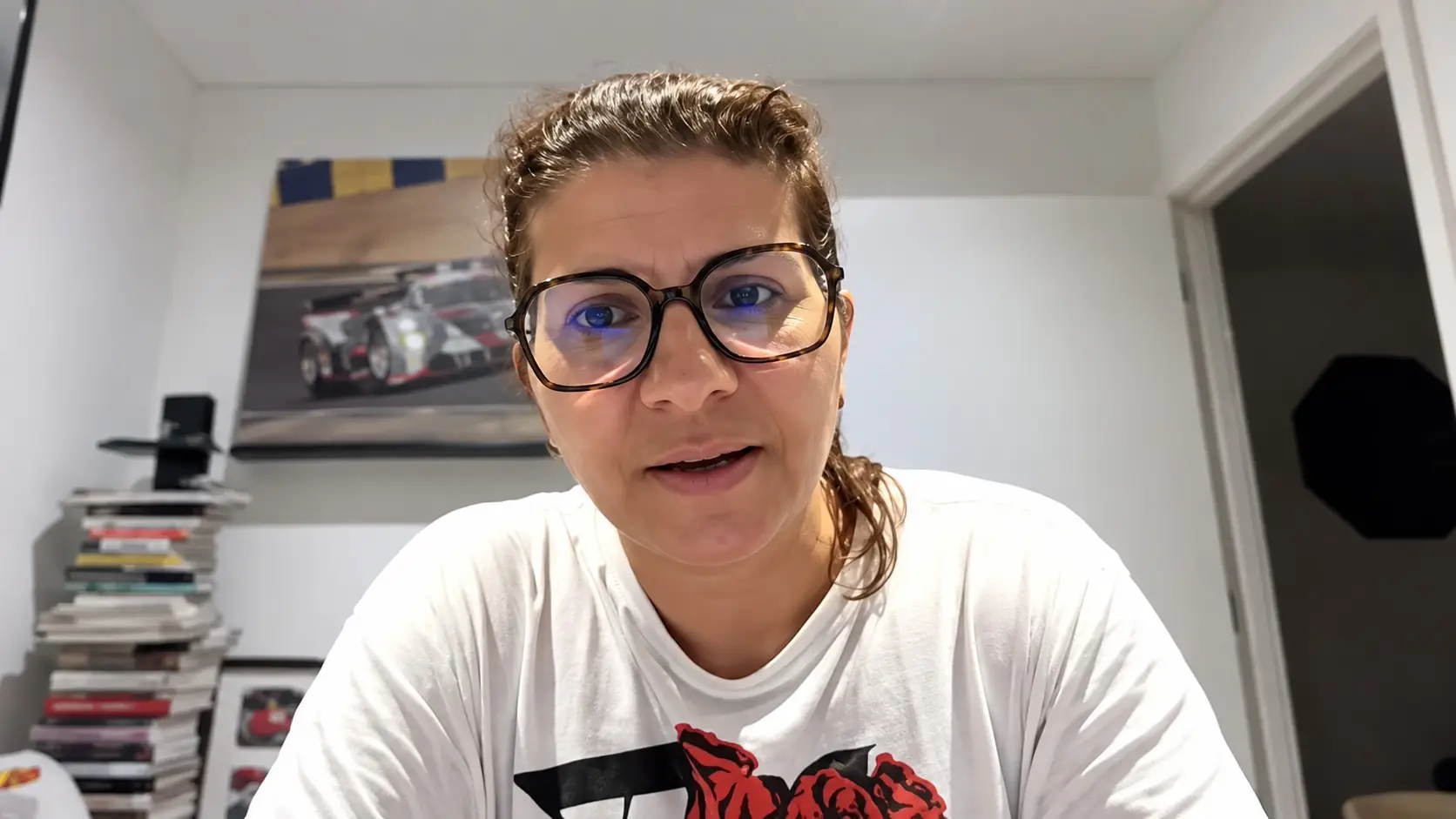
Before the lights went out at Sveg Raceway, the World eX community welcomed a guest whose name is written into the history of the 24 Hours of Le Mans.
Leena Gade became the first female race engineer to win Le Mans outright, and she went on to win it three times with Audi. Since then, she has worked in IMSA, IndyCar and Extreme E. In our Bizz Talk she talked openly about how she got into the sport, those nights at La Sarthe, the progress women have made in motorsport engineering, and where Formula 1 is heading.
Her route into racing was anything but direct. After university, with student debts to pay off, Leena started out in the automotive industry. She worked in noise, vibration and harshness (NVH) at Jaguar, then at MIRA, the Motor Industry Research Association in Nuneaton. At weekends she volunteered as a data engineer, often for little more than her expenses, working her way from Formula Vee to Formula BMW, A1 GP and GT racing. Her first Le Mans came in 2006 with a privateer Lola LMP1 team, the same year Audi arrived with its diesel R10. “It would be really nice to work for them one day,” she remembers thinking as she looked down the paddock. A few months later, a conversation with Howden Haynes about a completely different project turned into what she only later realised was a job interview. When Haynes pulled out a handbook with the R10 on the cover, she thought: “This is big.” After a short chat about her experience, he offered her the role. “And I was like, ‘Was that an interview?’” By April 2007 she was in St. Petersburg as Haynes’ assistant engineer at Champion Racing, working with Allan McNish and Dindo Capello. “I’ve never looked back since. It was one of the best opportunities I was given,” she said. “It set me up pretty much for the rest of my career, taking those concepts, those ideas, those philosophies along to do other stuff.”
Endurance racing is still where her heart lies. “By far, it’s one of the most enjoyable,” she said. She especially enjoyed IMSA, where “you have quite an impact on it as a race engineer because you call the strategy.” On the Mazda DPi programme with Multimatic, her team used the strategy model Joest Racing had developed during the Audi days. American racing also taught her how much dampers matter on bumpy circuits, a lesson that grew during her short time in IndyCar. Extreme E was “the outlier”: a project first run in partnership with McLaren. Formula 1 was a childhood dream, inspired by Senna, Prost, Mansell and the active-suspension cars of the early 1990s. But she is wary of how specialised roles become in teams of 400 or 500 people. “You become very specialized in Formula 1. You’re very much centered on just one area,” she explained. Coming from endurance racing, where everyone in a team of 40 helps out across different areas, “I think that could get quite frustrating.” So F1 is “currently not on the list – but you never know.”
Her memories of Le Mans cover the whole range of emotions. In 2008, as Haynes’ assistant, she was part of the win for McNish, Kristensen and Capello, a race captured in the film ‘Truth in 24’. The Peugeots were three seconds a lap faster at the start, and the word she remembers from that weekend is ‘resilience’. Then came 2011, her first year as a lead race engineer. The build-up was rough: in Sebring and Spa her car ran out of fuel, and she honestly expected to be fired before Le Mans: “Those are such basic mistakes that you don’t make as a race engineer.” After Spa she asked her mechanics, engineers and drivers for brutally honest feedback. They told her she spoke too fast on the radio, changed her mind too often and didn’t believe in herself. “To say it was brutal would be an understatement,” she recalled. Benoît Tréluyer suggested the drivers should report only their top three issues instead of a hundred. Her new rule was simple: “Take a deep breath before you open the radio channel, then speak, and make a decision. And if it’s wrong, it doesn’t matter, we’ll fix it.” The car took a surprise pole on 20-lap-old tyres. Then Allan McNish had his huge crash, and late at night Mike Rockenfeller had his terrible accident, with the team going what felt like hours without knowing how he was. In the end it was one Audi against four Peugeots. On Tom Kristensen’s advice, the last stop included four new tyres instead of changing one tyre that had a slow puncture. André Lotterer crossed the line with only a tiny margin.
“To say I had no idea what the hell had happened would be an understatement, because it was just a race in my head. We had to get it done. The emotion that I saw in the rest of the Audi team is something that will live with me forever.” The team, she said, “was like a family.” It took three or four months before it sank in: “Wow, we just won Le Mans.”
Her worst Le Mans was 2016, her last year with Audi: a new battery hybrid concept, no completed endurance test, and a car she simply “hated”. “I’ve never had such a bad Le Mans, ever, in the nine years I was there.” From Tom Kristensen and the other Audi drivers she learned a lesson that has stayed with her, no matter how good the simulation models are: “If you don’t focus on drivability, you’re not gonna be able to get round Le Mans.”
On women in motorsport engineering, Leena was clear that she never felt treated differently at Audi Sport or Joest. “I was treated as an equal, but moreover, I was there on merit.” The doubts came mostly from herself: “It took a couple of years for me to believe in that myself.” After her first win, joining the hybrid test team gave her real influence on how the car was developed, and in 2012 she was driven by one goal: to prove to “literally everybody on planet Earth” that she wasn’t a one-hit wonder. “I didn’t think about it from a gender point of view. I just thought, ‘I don’t want anyone to think that this was handed to me.’”
She has seen the paddock change. Walking through Daytona a few years ago with her German data engineer Svenja Heyer, they noticed female tyre fitters in the Michelin tent and female mechanics and engineers in almost every garage. “Things have really moved on,” Heyer said. “It’s become much more accessible,” Leena added. She pointed to Hannah Schmitz’s strategy work at Red Bull and to female race engineer Laura Müller at Haas in Formula 1 as signals to young people of any gender. Encouraging young women is important, she said, but just as important is educating everyone that racing “doesn’t see gender. You have to just have the best people. Sometimes you have to make a decision with only 80 percent of the information, and if you have the skills to do that, there is a place for you in racing.”
Looking ahead, Leena sees AI helping teams process huge amounts of data. That matters more than ever with today’s big Hypercar grid, though she doesn’t expect it to make live strategy calls yet, or to replace a lot of jobs. “Whether it comes and takes over a whole load of jobs, I’m not so sure.” On simulators, she said: “They are only as good as what you put into them. If you put in junk, you’re gonna get out junk.” Since she started using them seriously at Multimatic around 2019, they have become a key training tool for young engineers.
Asked about F1’s current rules, she finds the energy-management challenge familiar from her LMP1 days and interesting from an engineering point of view. “I don’t necessarily think that F1 have got it right at the moment,” she said, pointing to the difficult balance between a new mass audience and technical fans, and she notes that the drivers don’t seem to enjoy it much. Talk of going back to combustion engines, however, feels to her “a little bit like they’re looking backwards”. For manufacturers like Audi, under heavy cost pressure at home, it is hard to explain to a board why they should spend millions on technology that doesn’t match their road car range. “You don’t often see so many V8s on the road now. But it’s the pinnacle of technology in motorsport, so maybe they get away with it.”