Roger Köhler’s journey from motorsport mechanic to pioneering force in the renewable energy sector is rich in lessons for today’s rapidly evolving industries. During the latest World eX Bizz Talk, Köhler shared insights that illuminate his path and reveal how the mindset and skills honed in motorsport can accelerate progress in the energy sector, particularly with regard to the urgent challenge of building a flexible, reliable grid for the future.
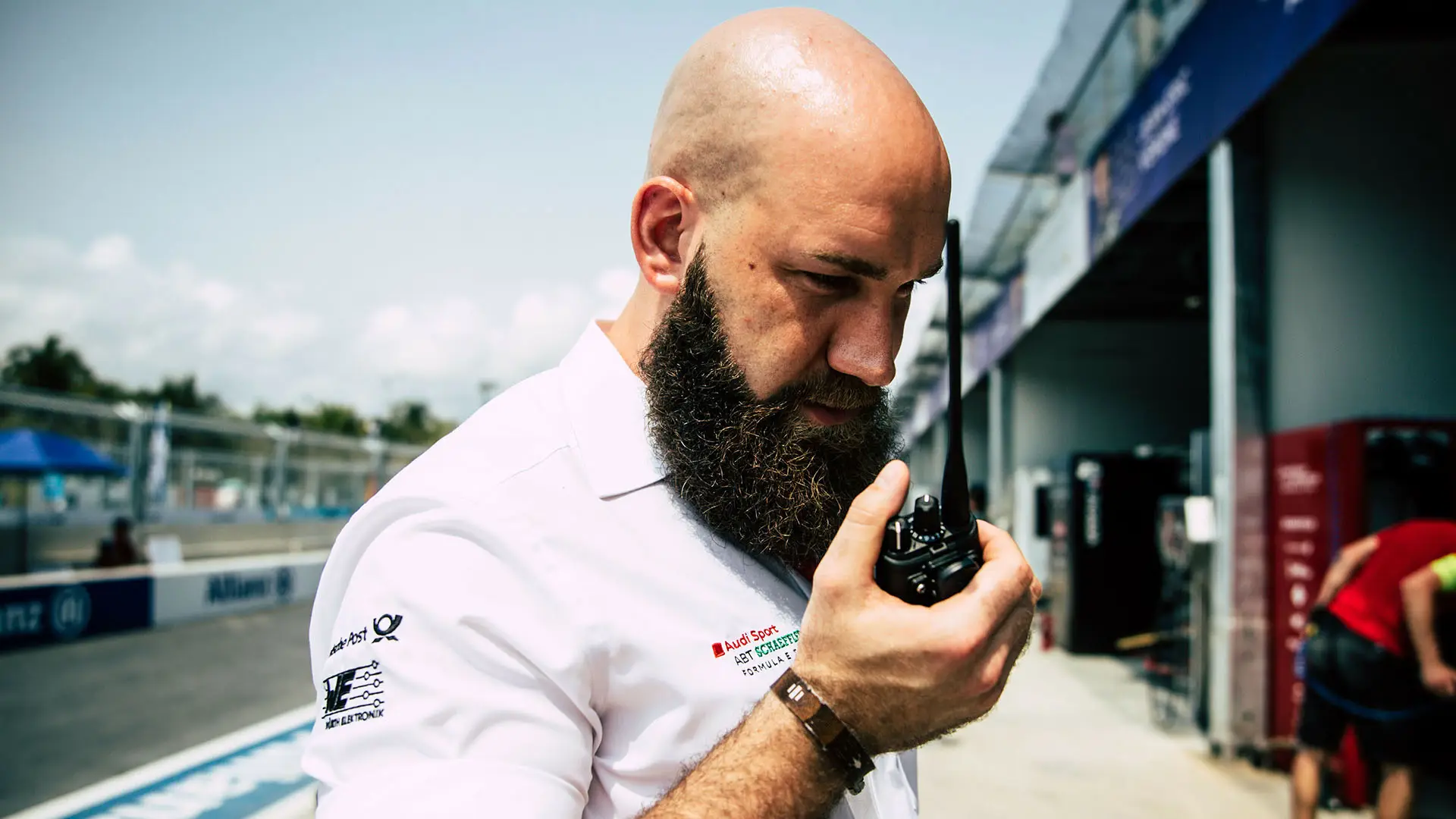
Köhler began his career almost by accident, starting as a BMW mechanic before entering the world of motorsport. He spent his early days building rally cars and participating in the legendary Dakar Rally. These experiences taught him the value of teamwork, rapid problem-solving and adaptability. Working with successful teams such as ABT Sportsline and X-raid in both rally and circuit racing taught him to manage complex projects, coordinate large teams, and deliver results under tight deadlines.
This environment, where every second counts and every team member’s contribution is vital, shaped Köhler’s approach to both motorsport and business. He later transitioned into engineering within the Audi Sport ABT Schaeffler Formula E Team, where he developed software for automatic pit stop systems in Formula E. “I was able to delete human error to basically automate the complete pit stop system, which helped us to gain tenths of a second,” the German says. This relentless focus on efficiency and precision has become a hallmark of his work, both on the racetrack and in the energy sector.
After nearly 15 years in motorsport, Köhler sought a new challenge. A conversation with a colleague led to the establishment of Cellmind, a company specialising in lithium-ion battery storage systems for renewable energy. “We can install it as a standalone unit or integrate it with a PV or wind system,” he explains. The goal is to help Germany build the energy infrastructure it needs for a sustainable future. Köhler highlights the urgency of this mission: “In Germany, we currently have four gigawatt hours of electricity stored in utility-scale batteries, but we will need 67 gigawatt hours by 2035.”
One of the most compelling takeaways from Köhler’s talk is how the culture and mindset of motorsport can benefit the energy sector. “We come from motor racing. Our mentality is that we need to deliver. If the pit-exit light turns green at seven o’clock, you need to deliver. This is how we operate in the company too, and we try to motivate our staff and our people with this mentality,” he emphasises. This mentality, which is rooted in teamwork, adaptability and a relentless drive to deliver, is invaluable in a sector where innovation and rapid deployment are critical.
Köhler’s experience shows that the ability to coordinate diverse teams, manage crises and innovate under pressure is essential not just on the racetrack, but also for building the energy systems of tomorrow. He is passionate about creating real impact: “I see great potential in working in this sector and having a real impact. Formula E is great of course, trying to promote sustainability and drive the energy sector forward. But a real impact by flexibilising the grid is even more powerful than racing on circuits, to be honest.” His vision is clear: “We want to build the backbone of Germany’s energy system, support the transition to renewable energy, and make the grid more flexible.”
Köhler’s approach is practical and inclusive. He notes that many of his clients are private landowners, particularly farmers, who lease their land for battery installations and receive a significantly higher income than they would from traditional farming. “This is, I would say, ten times more than if they rented it to a farmer or someone else,” he points out. Cellmind also works with industrial companies to help them manage their energy use more efficiently and offers solutions for households, enabling individuals to participate in the energy market. “We believe that battery energy storage systems are needed in all areas, from households to industrial companies and large battery parks, as well as in co-location systems with PV and wind turbines,” he says.
Köhler’s journey is a testament to the power of transferable skills and the importance of adaptability. His story is not just about personal success, but also about how the lessons of motorsport – teamwork, innovation and a results-driven mindset – can accelerate the energy transition. As the world races towards a sustainable future, the energy sector has much to learn from those who have already mastered high-performance teamwork and rapid innovation.
Find out more about Cellmind: https://cellmind.tech
The World eX Bizz Talk takes place before every World eX race via Zoom and features conversations with interesting personalities who have a close connection to our topics of motorsport, sim racing or the energy transition. Join our unique sim racing community to take part in the talks and ask your questions.