
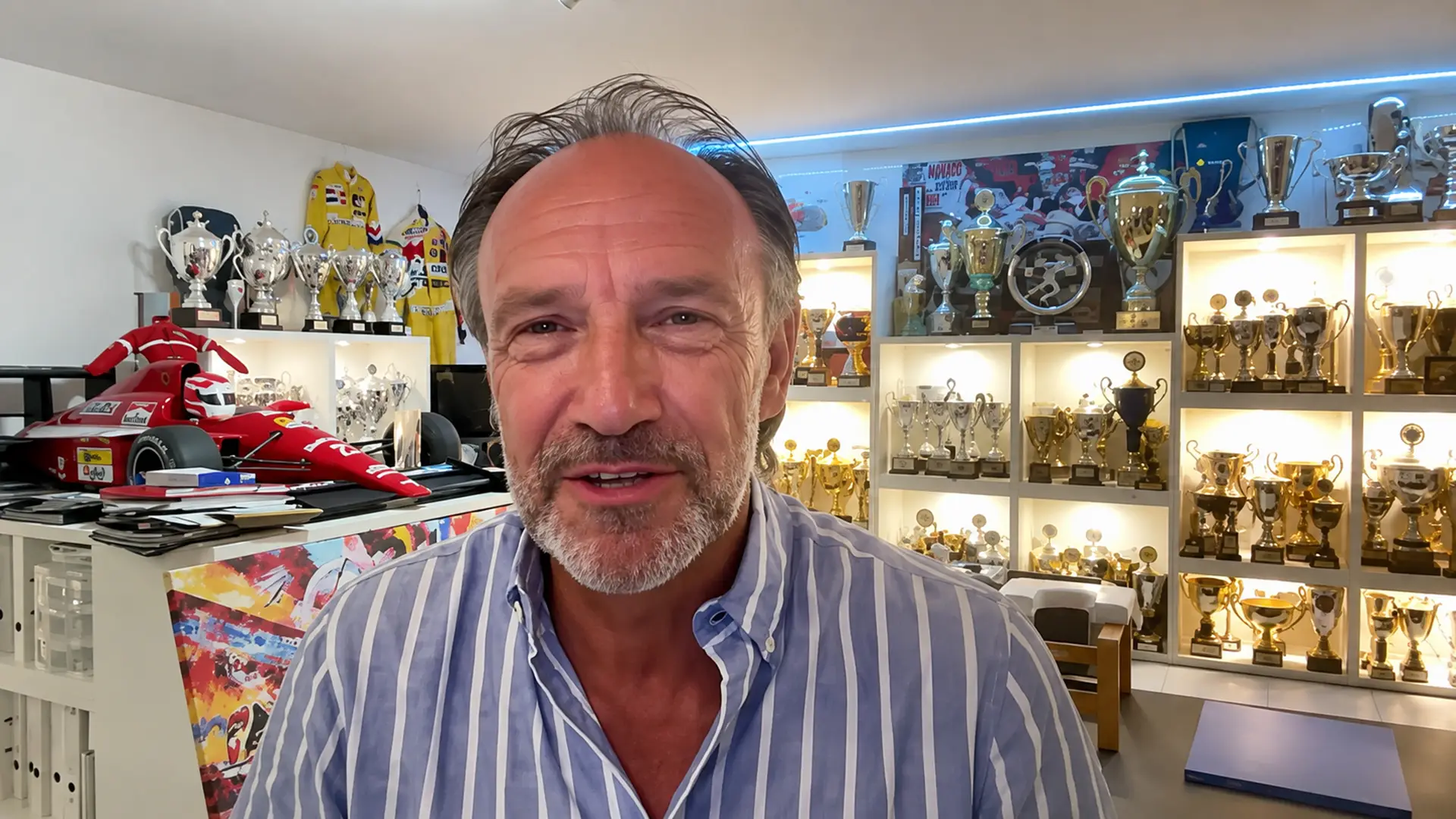
German racing driver Marco Werner was the latest guest of the RCCO World eX Bizz Talk, offering the community a candid look back at a career shaped by talent, persistence and an unwavering Formula 1 dream.
Marco Werner’s story led from a self-built Formula Ford to three overall victories at the 24 Hours of Le Mans – before historic racing finally allowed him to race Formula 1 cars at venues such as Monaco.
For the German, the destination was clear from the outset. “For sure, when you start in formula cars, the dream is Formula 1,” he said. Yet his route into motorsport was far from conventional. Karting was not financially possible, even though it was his original ambition, so he and a friend of his father built a Formula Ford 1600 themselves. “It was very cheap and the only possibility for me to start in racing,” Werner recalled.
His father had raced in the 1960s and 1970s, but there was no sponsorship money waiting for the next generation. Werner began with a simple, self-built car, then worked his way through Formula Ford and the Opel Lotus Challenge towards Formula 3. The prospect of Formula 1 still felt distant, but the move into Formula 3 gave his dream a new level of realism. “The Formula 3 in this time, the technique looking like little Formula 1 cars, that was my first dream,” he explained.
The talent was there. Werner won the Monaco Formula 3 Grand Prix in 1992 and finished runner-up in the German Formula 3 Championship, sharing the era with future Formula 1 stars. But professional motorsport is not determined by speed alone. The decisive problem was financial backing. “I never had a manager and sponsorships,” he said. “It was very, very difficult to make the next step to Formula 3000.”
Despite these barriers, Werner never left racing behind. His career took an alternative route through touring cars, GT racing and the Porsche Supercup. In 1999, after a season away from full-time competition, he drove four Nürburgring Nordschleife races in an Opel Astra Group N car simply for enjoyment. It was a modest programme, but it led to a crucial opportunity when Infineon offered him a Porsche Supercup drive for 2000.
The Porsche Supercup became Werner’s second beginning. He described the series as a hard but valuable school, where tightly matched cars and close racing gave little room for error. His performances, as well as Infineon’s connection with Audi, opened a door that would change the course of his career.
Audi offered Werner a one-race contract for the 2002 Le Mans 24 Hours, placing him in the manufacturer’s third LMP1 prototype. At the time, he had visited Le Mans only one year earlier as an Infineon guest and imagined how special it would be simply to contest the race in a GT2 car. “We never expect that we race an LMP1 car and that we finish on the podium the next year and the year after,” he said.
The step from Porsche Supercup machinery to an Audi LMP1 prototype was enormous. Werner’s comparison captured the scale perfectly: “It is like you’re flying as a hobby pilot with a Cessna … and then they bring you in an F16.” He immediately loved the speed and technical sophistication of the prototype, despite having only a single Le Mans appearance guaranteed. “I made a good job, and that was the start in my next step, in a good career,” he said.
That next step became a remarkable success story. In 2003, Werner joined Audi and Joest Racing in the American Le Mans Series, arriving in the United States without prior knowledge of the circuits. He nevertheless won his first race, the 12 Hours of Sebring, alongside Frank Biela. “You come to America for the first time, you haven’t a clue about the racetrack, and then you go back as a winner from the first race,” Werner said.
He and Biela won the 2003 American Le Mans Series title, followed by another championship in 2004 with JJ Lehto at Champion Racing. Werner also became a central figure in Audi’s Le Mans programme, ultimately taking three overall victories in the French endurance classic. What began as a one-off third-car opportunity had become a place in one of the world’s leading factory teams.
After leaving Audi’s prototype programme, Werner continued racing in GT3 cars. But a new, more personal chapter started in 2013, when nine-time Le Mans winner Tom Kristensen invited him to Denmark to race a Lotus Cortina. “That was my first race ever in historic racing,” Werner said. “That was really nice.”
Historic racing soon became much more than an occasional outing. Werner bought his former 1992 Monaco-winning Formula 3 car, restored it for track activity and gradually built a programme around historic cars. He described historic racing as “a journey into all the times” – an opportunity to experience the cars, sounds and physical demands of earlier eras first-hand.
His historic career brought another major victory in 2016, when he won Le Mans Classic in a Porsche 936 with Kremer Racing heritage. The experience was demanding: the car still reached around 320 km/h, but its heat, brakes and physical workload were worlds away from the more refined Audi prototypes Werner had raced in the 2000s. “One hour in this car, it was really far away from doing three hours with the modern cars from Audi,” he said.
Most importantly, historic racing ultimately brought Werner to the category he had always wanted to reach. He has raced a wide variety of Formula 1 cars, including the six-wheeled Tyrrell, a Nigel Mansell Lotus, Ferrari’s 1961 “Sharknose”, René Arnoux’s 1983 Ferrari and Niki Lauda’s 1974 Ferrari.
Driving Lauda’s Ferrari in Monaco was particularly emotional. “That was really special, to drive Niki’s car,” Werner said. Lauda later watched onboard footage from Werner’s run and praised the drive – a memorable endorsement for a driver whose early Formula 1 hopes had been blocked by finances rather than ability.
Today, Werner races mainly with the Black and Gold Collection, a remarkable group of Lotus and John Player Special-liveried racing cars. The collection includes around ten Formula 1 cars, as well as machinery such as a BMW Group 5 racer, a Trans-Am car and a Lotus-branded LMP2 prototype.
For the man who once built his own Formula Ford because karting was too expensive, the circle has closed in the most unexpected way. “Maybe I found my dream now,” Werner said.